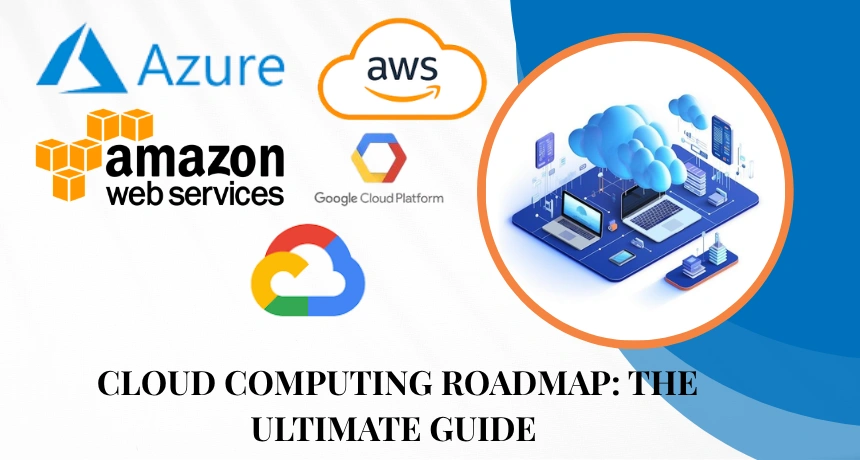
The Ultimate Cloud Computing Roadmap (2026)
Cloud computing is no longer just "the future"—it's the engine powering today's AI revolution, global applications, and digital transformation . The market is massive, with the "Big Three"—Amazon Web Services (AWS), Microsoft Azure, and Google Cloud Platform (GCP)—controlling roughly 63% of the global cloud infrastructure market . And the demand for skilled professionals has never been higher. According to industry reports, cloud certifications rank among the highest-paying in tech, with specialized roles commanding well over $175,000 annually in the U.S. .
So, where do you start? How do you choose between AWS, Azure, and GCP? This comprehensive roadmap is your high-SEO guide to navigating the cloud landscape, building in-demand skills, and launching a lucrative career in 2026.
The "Big Three" Showdown: Which Cloud Platform is Right for You?
Choosing a cloud provider is the first major decision. While all three offer similar core services (compute, storage, networking), their strengths cater to different needs.
| Feature | AWS | Azure | GCP |
|---|---|---|---|
| Best For | Broad enterprise workloads, maximum service breadth, and the most mature ecosystem . | Microsoft-integrated enterprises, hybrid environments, and strong enterprise IT integration . | Data analytics, AI/ML, and cloud-native, containerized applications . |
| Core Strength | Largest and most mature ecosystem with the most extensive service catalog (200+ services) . | Seamless integration with Microsoft products (Active Directory, Office 365, Windows Server) . | Leadership in Kubernetes, data analytics (BigQuery), and advanced AI/ML tools like Vertex AI . |
| Unique Advantage | Market leader with the widest global adoption and job opportunities . | "Azure Hybrid Benefit" allows using existing Windows/SQL Server licenses in the cloud . | Custom silicon (TPUs) for AI and a private global fiber network for consistent performance . |
| Ideal Buyer Profile | Enterprises needing max flexibility and scale . | Orgs running the Microsoft stack or hybrid . | Data teams, ML-heavy workloads . |
The Verdict? If you're unsure, start with AWS. Its concepts translate easily to other clouds, and it has the most learning resources . If you're in a heavily Microsoft-centric environment, choose Azure. If you love data and AI, choose GCP.
Your 6-Phase Roadmap to Cloud Mastery
This roadmap is designed to take you from absolute beginner to job-ready. Remember, cloud engineering is not an entry-level role; you typically need foundational IT experience (1-2 years in support, admin, or development) to truly succeed . Focus on one certification + one major project to become interview-ready .
Phase 1: The Fundamentals (Linux, Networking & Scripting)
Difficulty: Beginner | Time: 4-8 Weeks
This phase is crucial. Don't rush it.
-
Focus Areas: Linux fundamentals (command line, SSH), TCP/IP networking, DNS, HTTP/HTTPS, and Python/Bash scripting .
-
Action: Set up a Linux virtual machine, access it via SSH, and write a Python script to automate a simple system task .
Phase 2: Start Working with a Cloud Platform
Difficulty: Beginner-Intermediate | Time: 6-10 Weeks
Pick one platform (e.g., AWS) and learn its core services.
-
Focus Areas: Compute (VMs), object storage, virtual networking (VPCs), Identity and Access Management (IAM), and managed databases .
-
Action: Deploy a simple web application connected to a managed database .
Phase 3: Infrastructure as Code & Automation
Difficulty: Intermediate | Time: 4-6 Weeks
Stop clicking in the console ("ClickOps") and start writing code to manage your infrastructure.
-
Focus Areas: Learn Terraform (the industry standard), Git for version control, and CI/CD fundamentals (Jenkins, GitHub Actions) .
-
Action: Write a Terraform script to provision an entire cloud environment (VMs, networks, databases) .
Phase 4: Containers & Orchestration
Difficulty: Intermediate | Time: 4-8 Weeks
Most modern applications run in containers managed by Kubernetes.
-
Focus Areas: Docker (containerization) and Kubernetes (orchestration). Learn to build images, run containers, and deploy applications to a Kubernetes cluster .
-
Action: Containerize your web app using Docker and deploy it on a managed Kubernetes service (like EKS, AKS, or GKE) .
Phase 5: Cloud Security, Monitoring & Cost Optimization
Difficulty: Intermediate | Time: 3-5 Weeks
Learn to secure, observe, and optimize your cloud environment.
-
Focus Areas: IAM best practices (least privilege), configuring monitoring dashboards (CloudWatch), troubleshooting, setting up alerts, and identifying waste to reduce cloud costs .
-
Action: Configure a monitoring dashboard and set up cost alerts for your cloud project .
Phase 6: Build a Cloud Project Portfolio
Difficulty: Intermediate-Advanced | Time: Ongoing
This is where you prove your skills. Build a "production-style" project that combines everything you've learned.
-
Sample Project: The Cloud Resume Challenge. Host a static website, connect it to a serverless API (e.g., AWS Lambda), use a database (DynamoDB), and deploy everything using Infrastructure as Code and a CI/CD pipeline .
-
Project Ladder: Start by hosting a static website, then deploy a cloud-native web app, provision infrastructure with IaC, containerize the app, and finally, create an end-to-end cloud solution .
The Certification Path: Your Career Accelerator
Certifications validate your skills and are highly valued by employers. Here are the most impactful ones:
Foundational (Entry-Level)
-
Who: Beginners or non-technical roles.
-
Certifications: AWS Certified Cloud Practitioner or Microsoft Azure Fundamentals (AZ-900) .
-
Salary Impact: $100,000 - $120,000 (US average) .
Associate (Intermediate)
-
Who: Cloud engineers, administrators, and architects.
-
Certifications: AWS Solutions Architect Associate (SAA-C03) (The "gold standard") or Azure Administrator (AZ-104) .
-
Salary Impact: $125,000 - $155,000 (US average) .
Professional / Specialty (Advanced)
-
Who: Senior engineers, architects, and security specialists.
-
Certifications: AWS Solutions Architect Professional, Azure Solutions Architect Expert, Google Professional Cloud Architect, AWS Security - Specialty, Azure AZ-500 .
-
Salary Impact: $155,000 - $221,000+ (US average) .
The "Golden Rule"
One solid certification + One major project = Interview Ready . Avoid becoming a "paper tiger"—someone with certifications but no practical experience. Employers value hands-on skills above all.
Career Paths & Salary Outlook
Cloud roles are diverse. Here are some of the most in-demand in 2026:
The Builders (Infrastructure & Development)
-
Cloud Engineer: Builds and maintains infrastructure. Salary: $70,000-$95,000 (Junior) .
-
DevOps Specialist: Automates CI/CD pipelines and deployments. Salary: Up to $150,000 (Mid-level) .
-
Cloud-Native Developer: Writes code for serverless platforms. Salary: High demand.
The Strategists (Architecture & Business)
-
Cloud Architect: Designs the entire cloud blueprint. Salary: $130,000-$180,000+ (Senior) .
-
Cloud FinOps Analyst: Optimizes cloud costs. One of the hottest emerging roles .
The Protectors (Security & Compliance)
-
Cloud Security Specialist: Secures cloud infrastructure. Salary: $130,000-$180,000+ (Senior) .
-
DevSecOps Specialist: Builds security into the development pipeline .
The Specialists (Data & AI)
-
AI/MLOps Specialist: Manages infrastructure for AI models. Salary: High, growing fast .
-
Cloud Data Specialist: Builds ETL pipelines for big data .
Conclusion: Your Journey Starts Now
Cloud computing offers a clear, rewarding career path with immense earning potential. The demand for skilled cloud professionals is only going to grow. Start by picking one platform, follow this structured roadmap, and, most importantly, build real projects. Your future in the cloud starts today.
Contact Us
Phone: +91 9667708830
Email: info@codingnow.in
Website: https://codingnowai.in/
Address:
2nd Floor, Kapil Vihar (Opp. Metro Pillar No.354)
Pitampura, New Delhi – 110034
Backlink to main website: Explore AI and business technology courses at Coding Now – Gurukul of AI