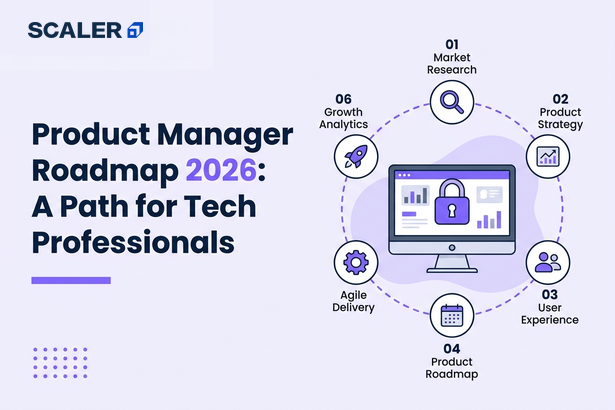
Product Management Roadmap 2026
Product management has become one of the most coveted career paths in technology, and 2026 presents a golden opportunity. India now has 100+ unicorns, 1,200+ funded startups, and a SaaS sector that crossed $13 billion in revenue—each of these companies needs skilled PMs to build, scale, and evolve their products . Here's your complete roadmap to break into this exciting field.
What Does a Product Manager Actually Do?
A Product Manager sits at the intersection of business, technology, and user experience. They don't write code or design screens, but they deeply influence all three. Think of them as the "connective tissue" of a product organization .
Core Responsibilities:
-
Product Discovery & Research – Talking to users, analyzing data, studying competitors to identify real problems worth solving
-
Strategy & Roadmapping – Deciding what to build, when, and why—and just as importantly, what not to build
-
Cross-functional Collaboration – Working with engineering, design, marketing, sales, and leadership to align everyone toward the same goal
-
Execution & Delivery – Writing Product Requirement Documents (PRDs), removing blockers, and ensuring features actually ship
-
Measurement & Iteration – Tracking metrics, analyzing performance, and feeding learnings back into the product cycle
One key distinction: A Project Manager ensures the team builds the thing right. A Product Manager ensures the team builds the right thing .
Types of Product Managers
Not all PM roles are the same. Here are the main specializations in 2026 :
| Role Type | Focus | Best For |
|---|---|---|
| Technical PM | Complex tech products, APIs, system architecture | Engineers transitioning |
| Growth PM | User acquisition, conversion rates, onboarding flows | Data-driven, numbers-obsessed |
| Consumer PM | Apps and products for everyday users (social media, food delivery) | Customer-centric thinkers |
| B2B Product Manager | Products for businesses, solving serious business problems | Strategic, enterprise-focused |
| Platform PM | Products that other products are built on top of | Systems thinkers |
Who Typically Becomes a PM?
There's no single background for PMs. People enter from surprisingly diverse paths :
-
Software Engineers – Leverage technical expertise and understanding of product development
-
Designers – Bring user empathy and research skills
-
Consultants & Analysts – Bring structured thinking and stakeholder management
-
Marketing Professionals – Bring market understanding and customer insight
-
Customer Success – Understand user pain points better than anyone
-
MBA Graduates – Strong foundation in business strategy and cross-functional perspective
The common thread isn't background—it's curiosity, comfort with ambiguity, and the ability to influence without authority .
The Product Manager Roadmap – Step-by-Step
Phase 1: Build Strong Foundations (Month 1-2)
Start by choosing a product you use daily—Spotify, Swiggy, Amazon, Instagram. Study how people interact with it, read app reviews, browse Reddit discussions, and collect feedback. Look for recurring complaints and unmet needs .
What to Learn:
-
Product Lifecycle (idea → launch → growth → decline)
-
User Personas & Customer Journey Mapping
-
Minimum Viable Product (MVP) concept
-
Stakeholder Management
-
Basic metrics and KPIs
Deliverable: A product research case study with user personas, journey maps, and documented user problems
Phase 2: Master Strategy & Prioritization (Month 2-3)
Take your list of problems and organize them into a backlog. Learn to decide what deserves attention first.
Key Frameworks:
| Framework | Purpose |
|---|---|
| RICE | Score features by Reach, Impact, Confidence, Effort |
| MoSCoW | Categorize as Must-have, Should-have, Could-have, Won't-have |
| OKRs | Set Objectives and Key Results for goals |
| Kano Model | Understand which features delight vs. just satisfy |
Deliverable: Prioritized backlog + RICE assessment + product roadmap
Phase 3: Data & Analytics (Month 3-4)
PMs live inside dashboards. Every decision is backed by data .
What to Learn:
-
SQL – Retrieve, filter, join, group, and analyze data
-
Google Analytics – Measure user engagement and product performance
-
A/B Testing – Compare different versions of a feature
-
North Star Metrics – Identify the single metric that best predicts long-term success
Tools to Practice: Google Analytics, Mixpanel, Hotjar, Optimizely (for A/B testing)
Deliverable: Metrics dashboard or analysis report
Phase 4: Execution & Agile Workflows (Month 4-5)
Now it's time to turn ideas into work that can be planned and delivered.
What to Learn:
-
Writing PRDs – Define the problem, solution, expected outcomes, and constraints
-
User Stories – Format: "As a [user type], I want to [action] so that [benefit]"
-
Agile/Scrum – Sprints, stand-ups, backlog grooming, release cycles
-
Technical Basics – Understand APIs, databases, and cloud basics enough to have smart conversations with engineers
Deliverable: PRD + user stories + sprint backlog
Phase 5: AI Product Management Fluency (Month 5-6)
AI is becoming an increasingly important part of product development. The World Economic Forum identifies AI, big data, and technological literacy among the fastest-growing skill areas .
What to Learn:
-
How to evaluate AI features (not build them, but understand their potential and limitations)
-
Concepts: prompts, hallucinations, context windows, model limitations, AI safety
-
How to propose AI-powered features that solve real problems
Deliverable: AI feature proposal with user flow, failure-case analysis, and success metrics
Phase 6: Build Your PM Portfolio (Month 6-8)
Your portfolio is what gets you hired—not your degree .
What a Strong Portfolio Needs:
-
2-3 in-depth case studies showing your process from discovery to execution
-
A product teardown of an existing product
-
A product roadmap you created
-
A PRD or feature specification
-
An AI feature proposal
How to Build Projects Without Experience:
-
Redesign a feature of an app you love
-
Volunteer for a non-profit
-
Take small freelance gigs
-
Join product management simulations
Essential PM Tools in 2026
| Tool | Purpose |
|---|---|
| Jira | Task tracking, agile workflows |
| Figma | Understanding designs, collaborating with designers |
| Miro | Roadmapping, brainstorming, user journey mapping |
| Notion | Documentation, PRDs, project planning |
| Productboard | Collecting feedback, prioritizing features |
| Google Analytics | Tracking user behavior and performance |
Career Path & Salary in India
Typical Progression:
| Level | Experience | Average Salary |
|---|---|---|
| Associate PM (APM) | 0-2 years | ₹10-15 LPA |
| Product Manager | 2-4 years | ₹15-22 LPA |
| Senior PM | 4-7 years | ₹22-40 LPA |
| Director of Product | 7-10+ years | ₹40-80 LPA |
| Chief Product Officer (CPO) | 10+ years | ₹100-200 LPA+ |
Top Hiring Cities:
Bengaluru, Mumbai, Delhi NCR, Hyderabad, Pune
Industries Actively Hiring:
B2B SaaS, Consumer Apps, AI-native companies, Fintech, Health Tech, EdTech, E-commerce
Is Product Management Right for You?
Product Management might suit you if:
-
You enjoy solving ambiguous problems without clear answers
-
You're energized by variety and context-switching
-
You influence effectively without authority
-
You genuinely find other people's problems interesting
It might NOT suit you if:
-
You prefer deep focus over constant context-switching
-
You want clear right answers (ambiguity stresses you out)
-
You need visible creative ownership (PM influence is often invisible)
Quick Answers to Common Questions
Do I need a technical background? No. You don't need to code—but understanding technology helps you collaborate better with engineers. Curiosity across every part of the system is essential .
Can I transition without an MBA? Yes. Many PMs come from engineering, design, marketing, consulting, or even teaching. What matters is the skillset, not the degree .
What's the best way to get hands-on experience? Start with case studies, product teardowns, and live projects. Internships through APM programs are also excellent entry points .
How do I prepare for PM interviews? Expect behavioral questions ("Tell me about a time you dealt with conflict"), product sense questions ("How would you improve YouTube?"), and case studies/guess estimates .
Your Next Steps
-
Pick a product you use daily and create a product teardown
-
Take one structured course (Coursera, Scaler, or GUVI have good PM programs)
-
Build 2-3 portfolio projects with detailed case studies
-
Start applying for APM internships or entry-level roles
-
Network with PMs on LinkedIn and join product management communities
"A product manager needs to understand every layer of the business—from payment failures and API connections to marketing lead flows and business rules. It's not a role confined to one function." – Prasad Shankarwar, Director of Products
Contact Us
Phone: +91 9667708830
Email: info@codingnow.in
Website: https://codingnowai.in/
Address:
2nd Floor, Kapil Vihar (Opp. Metro Pillar No.354)
Pitampura, New Delhi – 110034
Backlink to main website: Explore AI and business technology courses at Coding Now – Gurukul of AI