DevOps Roadmap
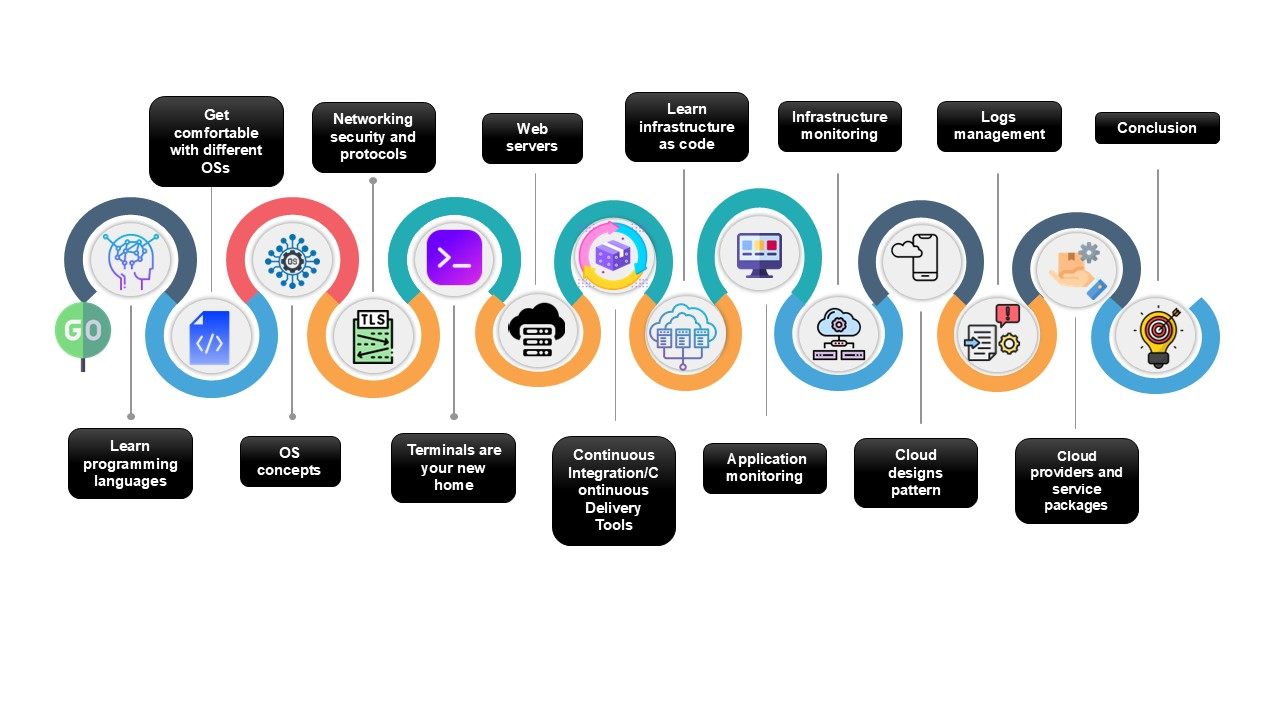
This roadmap guides you through the core pillars of DevOps, from foundational skills to advanced practices, equipping you to build and manage modern software delivery pipelines.
1. The DevOps Mindset: Culture Before Tools
DevOps is not a role or a set of tools—it's a practice. The goal is to shorten the cycle time from writing code to delivering it to users. The journey is as much about cultural transformation as it is about technical implementation.
Start with the "Why"
Instead of diving into tools first, understand your current state and desired outcomes. Ask: "How long does it take to deploy a change of one line of code?" This deployment time becomes the brake on your velocity.
Embrace Core Practices
Continuous Integration (CI): Automates merging code changes and running tests, catching issues within minutes of commits.
Continuous Delivery (CD): Enables rapid, low-risk deployments through smaller, frequent releases with automated rollback capabilities.
Avoid Anti-Patterns
Common pitfalls include creating a separate "DevOps team" (it's a practice, not a silo), starting with tools instead of culture, and bolting on security at the end.
2. The 4-Phase Implementation Roadmap
Adopt a phased approach to avoid overwhelming your teams:
| Phase | Focus | Key Activities |
|---|---|---|
| Phase 1: Foundation | Establish version control (Git) | Basic CI/CD pipeline, monitoring & alerting setup |
| Phase 2: Automation | Expand automation across the pipeline | Infrastructure as Code (IaC), security scanning, automated testing |
| Phase 3: Optimization | Fine-tune delivery and operations | Advanced deployment strategies (Blue-Green, Canary), performance tuning |
| Phase 4: Culture & Scale | Expand practices across teams | Establish centers of excellence, continuous improvement culture |
3. The Technical Roadmap: Skills and Tools
Here is the core technical stack every DevOps practitioner should master:
1. Version Control (Git)
The bedrock of all DevOps workflows. Use Git-based repositories like GitHub or GitLab for source control, code reviews, and integration triggers. GitHub alone has over 100 million developers and 4 million organizations using its platform.
2. CI/CD Pipelines (The Heart of Automation)
Automate building, testing, and deploying code. Popular tools include:
-
Jenkins: The industry-standard open-source automation server with extensive plugin support.
-
GitHub Actions: Integrated CI/CD with event-driven workflows.
-
GitLab CI: Built-in CI/CD with advanced deployment features like canary deployments.
-
Azure Pipelines: Enterprise-grade pipelines with deep Microsoft ecosystem integration.
-
CircleCI: Cloud-based or on-premises platform with focus on speed.
3. Infrastructure as Code (IaC)
Manage infrastructure using declarative configuration files (YAML/JSON). Terraform is the most popular provisioning tool, with alternatives like Ansible, Puppet, and Chef for configuration management.
4. Containers & Orchestration
Docker packages applications with all dependencies for consistency. Kubernetes automates deployment, scaling, and management of containers in production.
5. Monitoring & Observability
Gain real-time visibility into applications and infrastructure. The most popular tools are Prometheus (metrics) and Grafana (visualization). Cloud-based options include AWS CloudWatch and Azure Monitor.
6. Security & Compliance (DevSecOps)
Shift security left by embedding automated scanning (SAST, DAST, dependency scanning) into CI/CD pipelines. Tools like Snyk, SonarQube, and Checkmarx specialize in these capabilities.
4. DevOps Maturity Progression
DevOps is a journey through maturity levels:
| Level | Characteristics |
|---|---|
| Initial/Basic | Minimal automation, manual deployments, siloed teams |
| Developing | Basic CI/CD pipelines, automated testing, increased collaboration |
| Defined | Standardized processes, Infrastructure as Code, DevSecOps integration |
| Managed | Advanced automation, sophisticated monitoring, proactive incident management |
| Optimizing | AI-driven operations, predictive analytics, self-healing systems |
5. Project Ladder: Build Your Portfolio
Apply your skills with progressive projects:
| Level | Project Idea |
|---|---|
| Foundations | Automate a daily system backup and cleanup using Bash scripts |
| Core | Build a CI/CD pipeline that builds a Docker image and deploys it to a VM |
| Advanced | Deploy a highly available microservices app on Kubernetes with Prometheus monitoring |
| Expert | Implement a GitOps workflow using Argo CD and a Service Mesh |
6. Recommended Resources
Books:
-
The DevOps Handbook – Gene Kim, Patrick Debois, et al.
-
Accelerate – Nicole Forsgren, Jez Humble, Gene Kim.
-
Continuous Delivery – Jez Humble, David Farley.
Learning Paths:
-
Microsoft Learn: AZ-400 – Work with Git for Enterprise DevOps
Contact Us
Phone: +91 9667708830
Email: info@codingnow.in
Website: https://codingnowai.in/
Address:
2nd Floor, Kapil Vihar (Opp. Metro Pillar No.354)
Pitampura, New Delhi – 110034
Backlink to main website: Explore AI and business technology courses at Coding Now – Gurukul of AI