Blockchain Roadmap – Web3 Development Guide 2026
Blockchain and Web3 development is one of the fastest-growing tech fields in India, with job postings in the space growing by 552% . The sector already employs 50,000 individuals in India and continues to expand rapidly . This roadmap will take you from complete beginner to job-ready blockchain developer.
What Does a Blockchain Developer Actually Do?
The term "blockchain developer" covers two distinct roles, and confusing them is the most common mistake beginners make :
| Role | What They Do | Difficulty |
|---|---|---|
| Smart Contract Developer | Writes, tests, and deploys self-executing programs (smart contracts) on existing blockchains like Ethereum or Polygon | More accessible; 90% of entry-level jobs are here |
| Blockchain Core Developer | Builds the blockchain infrastructure itself: consensus protocols, networking layers, and node software | Much harder; requires deep systems knowledge |
This roadmap focuses on the smart contract developer path—the realistic starting point for 90% of entry-level blockchain jobs .
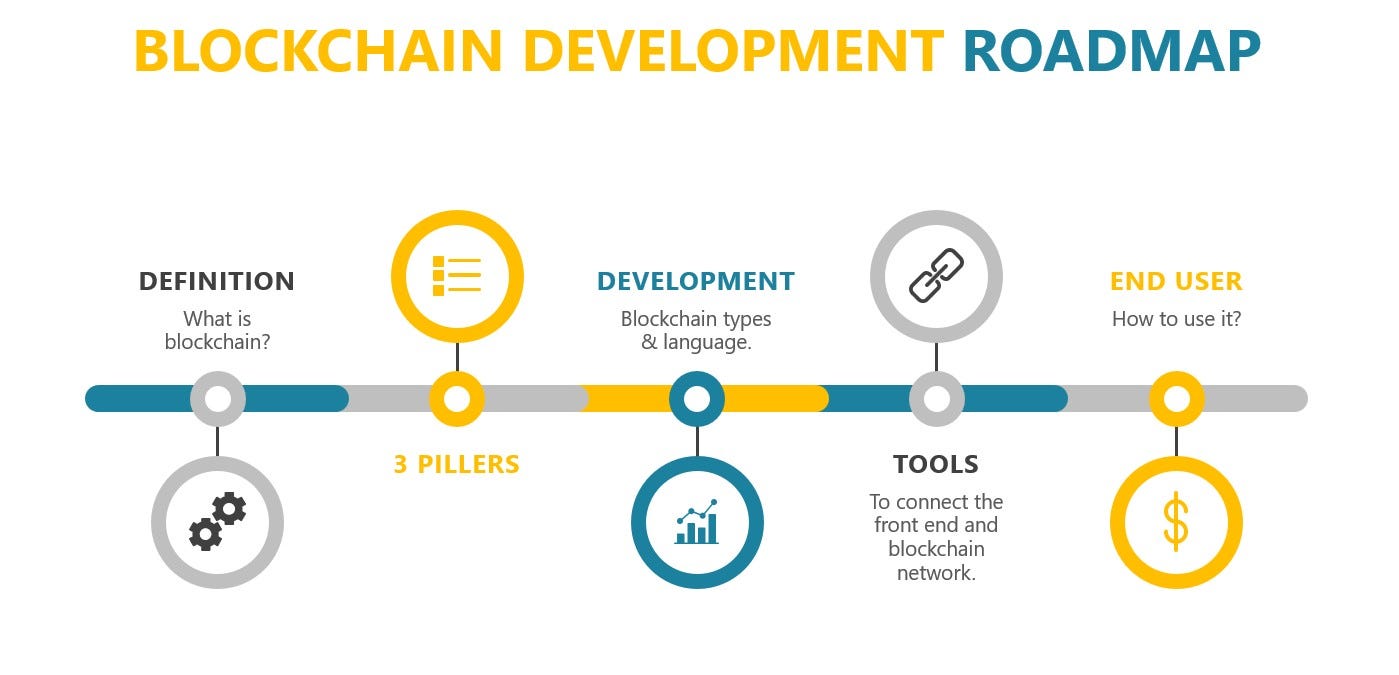
Phase 1: Programming & CS Foundations (Month 1-3)
This is the phase most blockchain roadmaps skip, and it's the one that determines whether you succeed or stall. You cannot write a smart contract if you cannot write a function .
| Prerequisite | What You Need to Know | Why It Matters |
|---|---|---|
| JavaScript | Variables, functions, async/await, modules, error handling | Web3 libraries (ethers.js, web3.js) use JavaScript |
| Data Structures | Arrays, hash maps, trees, graphs, complexity analysis | Gas costs depend on algorithmic choices |
| Object-Oriented Programming | Classes, inheritance, interfaces, polymorphism | Solidity is object-oriented |
| Basic Web Dev | HTML, CSS, DOM manipulation, HTTP, REST APIs | dApps are web apps with a blockchain backend |
| Git & CLI | Terminal navigation, repository management, branching | Every blockchain tool runs from the command line |
If you're starting from zero programming experience, budget 3-4 months here before touching blockchain .
Phase 2: Blockchain & Cryptography Fundamentals (Weeks 1-3)
Before writing a single line of Solidity, understand what a blockchain is and how it works .
| Topic | What You Learn | Outcome |
|---|---|---|
| What is a blockchain | Distributed ledger, immutability, blocks, chains, Merkle trees | Explain how data gets stored and verified on-chain |
| Consensus mechanisms | Proof of Work, Proof of Stake, finality | Understand how nodes agree on the state of the chain |
| Public-key cryptography | Private keys, public keys, addresses, digital signatures | Understand how ownership and authentication work |
| Hash functions | SHA-256, Keccak-256, deterministic output | Understand why tampering with a block invalidates the chain |
| Transactions and blocks | Transaction structure, gas, nonce, mempool | Understand what happens when you submit a transaction |
| Wallets and accounts | EOA vs Contract Accounts, MetaMask, private key management | Set up a wallet and explain account types |
Resources:
-
YouTube: Simply Explained, Whiteboard Crypto
-
Ethereum.org Developer Portal
Phase 3: Smart Contracts with Solidity (Months 2-4)
Solidity is the primary language for smart contracts on Ethereum and all EVM-compatible chains. It is the most requested skill in EVM-based job descriptions and should be your first priority .
| Topic | What You Learn | Outcome |
|---|---|---|
| Solidity basics | Contract structure, state variables, functions, modifiers | Write a basic contract with read and write functions |
| Data types and storage | Storage vs memory vs calldata, mappings, arrays | Understand where data lives and how gas costs are affected |
| Control flow and functions | If/else, loops, function visibility, view vs pure | Control contract logic and understand gas implications |
| Object-oriented patterns | Inheritance, interfaces, abstract contracts, libraries | Write modular, reusable contract code |
| Events and logging | Event declarations, emitting events, off-chain listening | Make contract activity observable from the frontend |
| Common patterns | ERC-20 (tokens), ERC-721 (NFTs), Ownable, Pausable, ReentrancyGuard | Implement standard interfaces the ecosystem expects |
| Gas optimisation | Storage vs computation trade-offs, unchecked blocks, packing | Write contracts that cost less to deploy and interact with |
Solidity vs Rust vs Vyper: Which Language?
| Language | Ecosystem | Best For |
|---|---|---|
| Solidity | Ethereum, Polygon, BNB Chain, Arbitrum, Base | Highest job volume; recommended starting point for most developers |
| Rust | Solana, Near, Polkadot (Substrate) | Experienced developers targeting high-throughput chains |
| Vyper | Ethereum (security-focused protocols like Curve) | Secondary language for security/auditing careers |
Most developers should start with Solidity—it has the largest job market, most learning resources, and is where Indian IT services companies are building their blockchain practices .
Resources:
-
Remix IDE (browser-based practice)
-
CryptoZombies (interactive learning)
Phase 4: Tooling & dApp Development (Months 3-5)
Writing a smart contract in isolation is not enough. You need to compile it, test it, deploy it, and build a frontend that interacts with it .
| Topic | What You Learn | Outcome |
|---|---|---|
| Development frameworks | Hardhat or Foundry: project setup, compilation, testing, deployment scripts | Scaffold, test, and deploy a smart contract project |
| Testing | Unit tests, integration tests, fuzz testing, coverage measurement | Write automated tests that verify contract behaviour |
| JavaScript libraries | ethers.js or web3.js: connecting to nodes, reading state, sending transactions | Build a frontend that reads from and writes to your contract |
| Wallet integration | MetaMask connection, transaction signing from the browser | Build a dApp users can interact with through their wallets |
| Testnet deployment | Sepolia testnet, getting test ETH, verifying contracts on Etherscan | Deploy a contract to a public test network |
Ecosystem comparison for 2026 :
| Ecosystem | Language | Tools | Best For |
|---|---|---|---|
| Ethereum & L2s (Optimism, zkSync) | Solidity, Vyper | Hardhat, Foundry, Remix, MetaMask | DeFi, NFTs, DAOs, general dApps |
| Solana | Rust (Anchor framework) | Solana CLI, Phantom | High-frequency trading, gaming, real-time apps |
| Cosmos | Go, Rust | Cosmos SDK, Tendermint | Appchains, cross-chain services |
Phase 5: Build a Project Portfolio (Months 4-6)
No one hires a blockchain developer based on course certificates alone—you need a portfolio of deployed, verified contracts with source code on GitHub .
Project Ladder (Start Simple, Then Scale)
| Project | Skills Proved | Difficulty |
|---|---|---|
| ERC-20 Token | Solidity basics, standard interfaces, testing, deployment | Beginner |
| NFT Minting dApp | ERC-721, IPFS integration, frontend wallet connection, full dApp stack | Intermediate |
| Voting System | Access control, time-based logic, state management, complex contract interactions | Intermediate |
| Land Registry dApp | Token standards (ERC-721), IPFS metadata, role-based permissions | Intermediate |
| Decentralized Exchange (AMM) | DeFi mechanics, liquidity pools, slippage, security | Advanced |
| Multi-Contract System | Factory patterns, upgradability, governance | Advanced |
What to include in every portfolio repository:
-
Clear README explaining architecture and setup
-
Tests with coverage for edge cases
-
Deploy instructions with testnet links
Phase 6: Security & Auditing (Months 6-8)
This phase separates developers who can deploy a contract from those who should be allowed to. Smart contracts handle real money—a single vulnerability can drain millions .
| Security Concept | What to Learn |
|---|---|
| Common exploits | Reentrancy, flash loans, oracle manipulation, access control bugs, signature issues |
| Testing | Static analysis (Slither), fuzzing (Echidna, Foundry), property-based tests |
| Audit prep | Threat modeling, invariants, access control documentation |
Recommended security learning path :
-
Complete CTF challenges (Ethernaut, Damn Vulnerable DeFi)
-
Participate in audit contests (Code4rena)
-
Publish documented write-ups explaining your approach
Decentralized Infrastructure & Advanced Topics
Decentralized Storage:
-
IPFS via Pinata or Web3.storage for NFT metadata
-
Arweave for permanent storage
Advanced Concepts to Explore:
-
Layer 2s: Arbitrum, Optimism, Base, zkSync
-
Account Abstraction (ERC-4337): Smart wallets, paymasters
-
Cross-chain bridges: Axelar, LayerZero
-
Oracles: Chainlink for off-chain data
Your 12-Month Action Plan
| Month | Focus | Key Deliverable |
|---|---|---|
| 1 | JavaScript + Git + CLI fundamentals | Build a CLI script reading on-chain data |
| 2 | Blockchain fundamentals + CryptoZombies | Complete blockchain basics course |
| 3 | Solidity basics + Remix | Deploy simple storage contract to testnet |
| 4 | Hardhat/Foundry + testing | ERC-20 token with full test suite |
| 5 | Frontend integration (ethers.js) + React | NFT minting dApp with IPFS metadata |
| 6 | Intermediate project | Voting system or land registry dApp |
| 7 | Security fundamentals | DeFi contract with fuzz tests |
| 8 | Advanced project (DeFi/AMM) | Documented threat model and test coverage |
| 9 | L2 deployment + multi-chain | Deploy to Arbitrum/Optimism testnet |
| 10 | Portfolio polish + Git documentation | 3-5 deployed, verified projects |
| 11 | Hackathon + open-source contribution | Public project on GitHub |
| 12 | Job applications + networking | Start applying to Web3 roles |
Career & Salary Outlook
Web3 Job Market in India
-
Blockchain job postings grew by 552%
-
India has 12,000+ blockchain-related job openings (4.5% of total active jobs)
-
Companies hiring: Web3 startups, enterprise IT firms (TCS, Infosys), global crypto exchanges
Salary Expectations (India)
| Level | Experience | Salary Range |
|---|---|---|
| Entry-Level | 0-2 years | ₹6-12 LPA |
| Mid-Level | 2-4 years | ₹12-25 LPA |
| Senior | 4-6+ years | ₹25-50+ LPA |
Quick Answers to Common Questions
Which blockchain ecosystem should I learn? Start with Ethereum/Solidity—it has the largest job market, most learning resources, and is where most Indian IT firms are building their blockchain practices .
Do I need to learn Rust? Only if you're targeting Solana or want to work on infrastructure-level blockchain development. For most beginners, Solidity is the smarter first investment .
Can I learn without a CS degree? Yes, but you need programming fundamentals first. JavaScript, data structures, and OOP are essential. Plan 3-4 months for these before touching Solidity .
What does "full-stack Web3" mean? A dApp has a React/Next.js frontend that connects to a smart contract backend via libraries like ethers.js. Full-stack Web3 developers build both .
Contact Us
Phone: +91 9667708830
Email: info@codingnow.in
Website: https://codingnowai.in/
Address:
2nd Floor, Kapil Vihar (Opp. Metro Pillar No.354)
Pitampura, New Delhi – 110034
Backlink to main website: Explore AI and business technology courses at Coding Now – Gurukul of AI